Deal slideshow ideas for shoppers in Germany.
Updated 26 October 2026
Two example slideshows
Wavegrain drew both with its own slide renderer, using free-licence photos. They are examples, not customer posts. Swipe through each one.
So erkennst du einen echten Deal
5 slides · Listicle structure · written in German
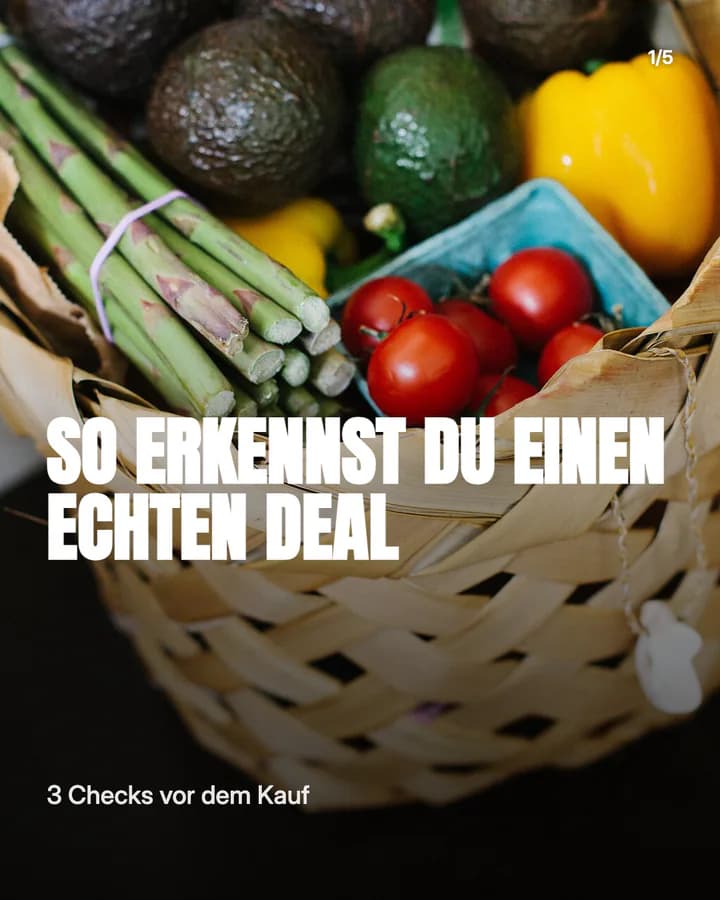


Deal-Check in 30 Sekunden
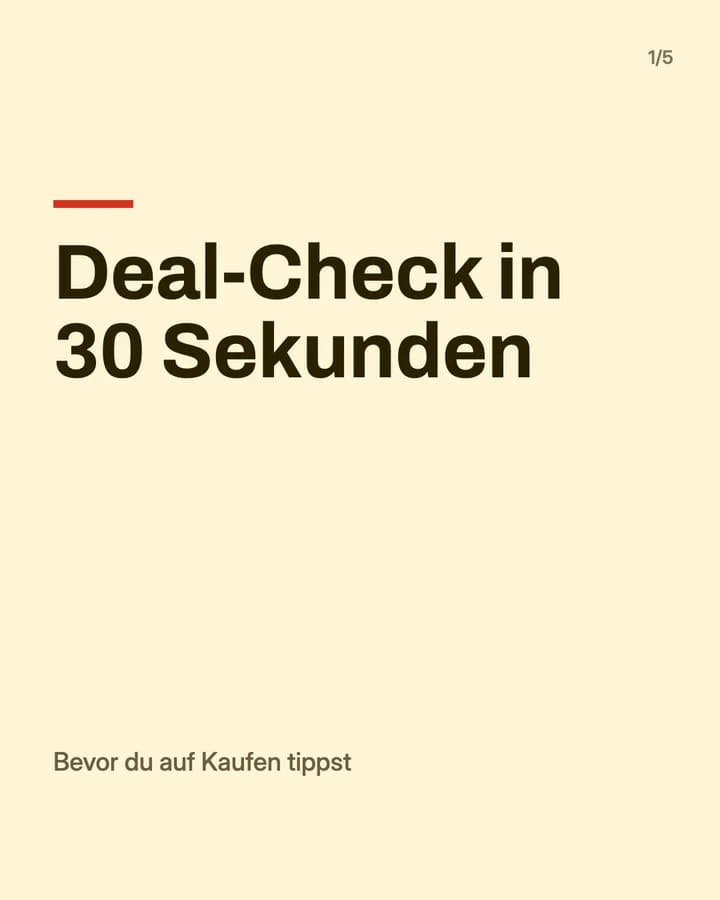
5 slides · Educational structure · written in German
10 hooks for German deals slideshows
“So erkennst du einen echten Deal”
Checklist. "How to spot a real deal." It promises a skill, not one offer, so the post stays useful after the deal ends.
“Deal-Check in 30 Sekunden”
Checklist. "Deal check in 30 seconds." A short time limit fits the moment just before someone taps buy.
“Die besten Deals der Woche”
Roundup. "The best deals of the week." A weekly roundup gives followers a reason to come back on the same day.
“Lohnt sich das wirklich?”
Question. "Is it really worth it?" It asks the question the reader already has about a discount.
“Diese Fehler kosten dich beim Online-Shopping Geld”
Mistake. "These mistakes cost you money when you shop online." People check their own habits against the list.
“Grundpreis in 3 Slides erklärt”
Explainer. "Unit price explained in 3 slides." Many shoppers see the unit price on every label but never use it.
“Marke vs. Eigenmarke: Was steckt drin?”
Comparison. "Brand vs own label: what is inside?" Two products side by side answer a question people have in the shop.
“Darauf achte ich am Black Friday”
Routine. "What I check on Black Friday." It speaks to a day when shoppers expect to be misled and want a plan.
“Rabatt-Mythen, die dich Geld kosten”
Myth vs fact. "Discount myths that cost you money." People swipe to check whether they believe one of them.
“Speichern für den nächsten Einkauf”
Save prompt. "Save this for your next shop." It tells the reader the post is useful at the moment they buy.
Formats that fit
Each format is a look and a post structure you can pick in Wavegrain.
Step-by-step explainer
Educational structure
A deal check in order, such as price history, unit price, then shipping and returns, one check per slide.
Numbered list
Ranking structure
The week's best offers, one per slide, each with the full price and the lowest price of the last 30 days.
Breaking news poster
CTA structure
One strong offer on a poster slide, with the full price, the end date and the Werbung label where it applies.
Myth vs fact
Educational structure
One belief about discounts or sales per slide, crossed out, with the plain fact under it.
A week of posts
- Monday
- Die besten Deals der Woche: the week's offers with full prices, one per slide.
- Tuesday
- A deal check shoppers can use before they buy, one check per slide.
- Wednesday
- Brand vs own label for one product, with the unit price of each.
- Friday
- One weekend offer as a poster slide, with the end date and the 30-day lowest price.
- Sunday
- Myth vs fact on one discount trick your followers asked about.
Rules to watch
- When a slide shows a price cut, add the lowest price of the last 30 days. German price rules (Preisangabenverordnung, PAngV section 11) require sellers to state it when they advertise a price reduction, and it keeps your post honest.
- Mark paid posts and affiliate links as Werbung or Anzeige, on the slide or at the start of the caption, and use the platform's paid partnership label too.
- Show the total price people pay, and say if shipping costs extra. Prices change fast, so say when you checked the price.
- Use product photos you have the rights to: your own, the shop's press images where its terms allow, or AI images that do not pretend to be the real product.
Questions
Can Wavegrain write the slides in German?
Yes. Wavegrain writes the slides in the language of the topic, so a German topic gets German slides and a German caption. Both examples on this page are in German.
Do I have to show the lowest price of the last 30 days?
Sellers must: PAngV section 11 says that when a price cut is advertised, the lowest price of the last 30 days has to be stated. Whether that binds a deal account that shares a shop's offer is less clear, so show it anyway, and ask a lawyer if you are not sure.
How do I mark affiliate links in a deal post?
Write Werbung or Anzeige where people see it before they tap, on the slide or at the start of the caption, and turn on the platform's paid partnership label when a brand paid you.
Does Wavegrain write the slides for me?
Yes. You give a topic, and Wavegrain writes the hook, the slides and the caption, places your photos or makes AI images, and keeps everything editable before you export it. Check every price before you post.
Which size should deal slideshows be?
1080x1920 (9:16) fills the screen on TikTok. For an Instagram carousel, use 1080x1350 (4:5) or 1080x1440 (3:4). Wavegrain exports all three.